If you want to know more information (such as product/process price, etc.), please contact us 24-hour telephone
How to build a stable concentrator and reach full production quickly is a key challenge for Chinese mining enterprises expanding into Africa. Xinhai delivered a full‑scope EPC+M+O (Engineering, Procurement, Construction + Management & Operation) wet‑processing production line 10 000 t/d heavy‑mineral‑sands project in Mozambique. The contract was awarded in May 2023; construction drawings were finalised in July 2023, and the whole project moved from drawing‑board to commissioned production in just over two months. This large‑scale heavy‑mineral‑sands project offers valuable lessons for reference.
Zirconium and titanium are strategic mineral commodities with highly concentrated global resources. The world’s total zircon reserves stand at around 75 million tonnes; Mozambique, South Africa, Kenya and Australia together account for 84 % of this total. Eastern Mozambique hosts laterite‑type and coastal placer‑type zircon‑titanium heavy‑mineral sands. Run‑of‑mine feed contains over 3 % TiO₂; minerals occur as discrete naturally‑liberated grains, making them relatively easy to separate. As Chinese mining investors turn their attention to the East African coast, constructing a reliable concentrator adjacent to mineral tenements is usually the first priority for developing heavy‑mineral‑sands deposits.
Nevertheless, coastal projects in this region bring inherent site‑specific hurdles: salt‑rich coastal atmosphere accelerates equipment corrosion, rainy seasons impose constraints on civil‑works timelines, and local spare‑part supply chains remain limited. All these real‑world local factors were weighed throughout the engineering phase of this Mozambican project.
The project contract was signed on 22 May 2023. Full construction documentation including steel‑structure, water‑supply‑and‑drainage and general‑layout drawings was completed and issued electronically on 27 July 2023 — a total turnaround of roughly 65 days. Design work was based on metallurgical test reports and proven operational data from comparable plants, with process flows confirmed after preliminary‑design review. Four core design principles were followed:
Proven‑process approach: Adopt mature, well‑proven domestic technologies and equipment, selecting appropriate flowsheets while meeting target product‑quality requirements;
Cost‑effective priority: Pursue sound overall economic performance with restrained capital outlay, short construction lead‑times and fast revenue realisation;
Site‑specific adaptation: Fully accommodate local realities of the Mozambican coast: natural topographic relief, coastal salt‑fog corrosion risk and seasonal‑rainfall impacts were all factored into layout and equipment selection;
Environmental‑compliance built‑in: Integrate waste‑treatment and pollution‑mitigation requirements at the construction‑drawing stage.
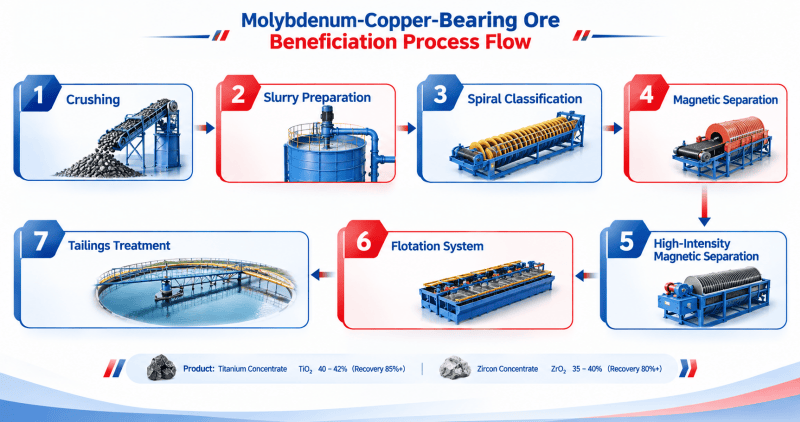
The main processing circuit consists of seven sequential unit operations with the following functions and outputs:
| No. | Unit Operation | Function / Output |
| 1 | Feeding & Pulping (waste‑discarding pre‑treatment) | Wet and disperse ROM ore; remove tramp impurities |
| 2 | Cyclone desliming | Classification and desliming to mitigate interference from fine‑size fractions |
| 3 | Spiral concentrator gravity separation | One roughing, one cleaning, one scavenging; separate zircon‑titanium minerals from silica sand |
| 4 | Low‑intensity magnetic separation | Recover titanomagnetite |
| 5 | High‑gradient high‑intensity magnetic separation | Produce rough ilmenite concentrate |
| 6 | Zircon‑beneficiation circuit (spiral rough‑scavenging + shaking‑table cleaning) | Generate rough zircon‑concentrate |
| 7 | Tailings handling | Dewater for stockpile; clarify and recycle process water |
Plant workshops adopt compact layout with centralised control. Ore slurry flows by gravity taking advantage of site topographic relief. Final product specifications: titanium concentrate TiO₂ 40‑42 % with overall recovery above 85 %; zircon concentrate ZrO₂ 35‑40 % with recovery above 80 %.
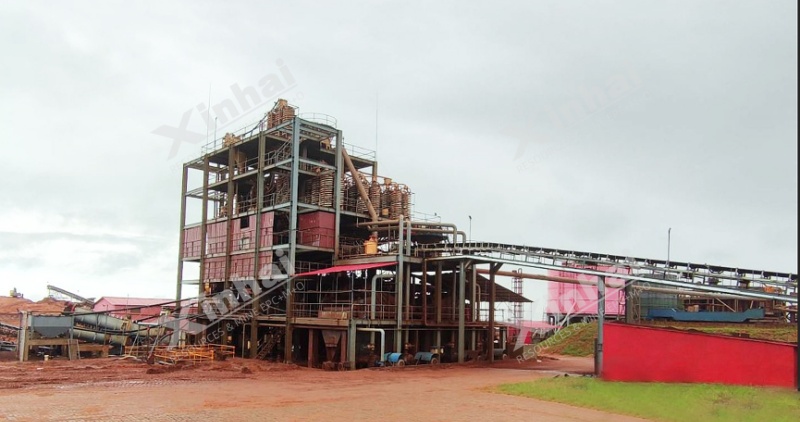
Commissioning lasted 33 days in total. Line 1 accumulated 756 operating‑hours. Key operational statistics are shown below:
| Indicator | Value |
| Commissioning duration | 33 days |
| Line 1 total runtime | 756 hours |
| Equipment availability (power‑outage time excluded) | 95.45 % |
| Cumulative ore throughput | 233 240 tonnes |
| Maximum daily feed capacity | 9 275 tonnes |
| Zircon‑concentrate production | 971.70 tonnes (equivalent to 313.96 tonnes zircon‑metal content) |
| Average yield / Average grade | 0.42 % / 32.31 % |
Two on‑site process optimisations delivered major cost‑saving and stability gains throughout commissioning:
Single‑lift gravity‑flow arrangement: Making full use of site topographic relief, Line 1 eliminated 8 intermediate slurry pumps compared with the reference circuit, cutting installed power demand by 500 kW;
“Five‑remove, one‑add” process adjustment: Remove selected cyclone‑classification, regrinding and intermediate‑intensity magnetic‑separation stages; add trash‑removal baffles ahead of high‑gradient magnetic separators. This shortens overall flowsheet while protecting critical high‑gradient‑magnetic‑separation equipment.
Commissioning represents practical iteration between theoretical process design and real‑site conditions. Stable target‑grade output marks successful hand‑over to full‑scale production.
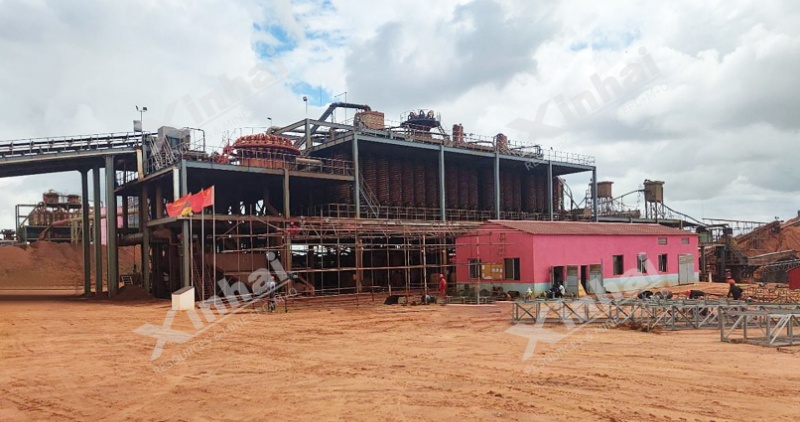
EPC+M+O integrates engineering, equipment supply, construction‑commissioning and production‑operation services end‑to‑end. Three replicable practical take‑aways were distilled from this Mozambican project:
Leverage topography for gravity‑driven slurry flow: Utilise coastal site relief to reduce pump count and cut power consumption;
Simplify flowsheets where feasible: Shorten processing circuits without compromising metallurgical targets and lower operational complexity;
Install protection for critical‑path equipment: Fit pre‑screening / trash‑removal devices upstream of high‑gradient magnetic separators and other key units to secure long‑term stable plant operation.
For enterprises planning to construct heavy‑mineral‑sands concentrators in Africa, cost‑efficient operation must be built‑in from project inception rather than retrofitted after plant startup. Lessons learned from this 10 kt‑d heavy‑mineral‑sands delivery have become transferable know‑how applicable to subsequent mineral‑sands projects.
Q: What are critical design points for heavy‑mineral‑sands concentrators on Mozambique coast?
A: Major practical factors include salt‑fog‑driven equipment corrosion, rainy‑season civil‑construction limits, on‑site topographic elevation for gravity‑flow slurry arrangement, and constraints on local spare‑part logistics. This 10 kt/d Mozambique EPC+M+O project incorporated these local conditions during early‑stage engineering.
Q: Can gravity‑flow slurry layout reduce operating cost for East‑Africa coastal placer mines?
A: When natural terrain elevation difference is available on‑site, gravity‑flow slurry design can cut pump quantity and power draw significantly, as proven in this Mozambique 10 000 t/d heavy‑mineral‑sands delivery case.
 +86 13811510145