If you want to know more information (such as product/process price, etc.), please contact us 24-hour telephone
Chromite processing has one organising question: where does the ore liberate? Every decision after that — how fine to grind, how many gravity stages, whether magnetics are needed — follows from the answer.
Get it wrong in either direction and the plant pays. Grind too coarse and locked chromite reports to tailings. Grind too fine and the slimes that gravity cannot catch carry the metal out with the water.
Chromite is brittle and relatively coarse-grained compared with many sulphide ores. In a coarse matrix, liberation commonly falls in the 0.1–1 mm band, which is why a chrome circuit often runs an open grinding stage followed by classification rather than a fine closed grind.
The failure mode is over-grinding. Below roughly 0.075 mm, gravity separation loses its grip — the particles are too light per unit surface to settle against the water flow inside a spiral or a table. Every extra tonne ground past that point costs power, produces slimes, and adds a recovery problem that the circuit downstream cannot solve.
The practical control is the grinding and classification stage working as a closed loop, with the cut set by testwork on the actual ore rather than by a standard mesh. Where the ore carries clay, scrubbing belongs ahead of that loop, not after it.
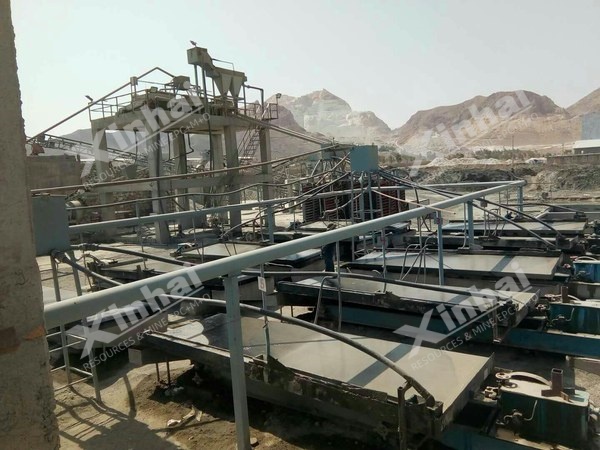
No single gravity device covers the full chromite size range. Each has a band where it separates properly, and a chrome circuit is arranged so that each band gets the device that matches it.
| Equipment | Particle range | Capacity | Concentrate Cr2O3 | Stage |
|---|---|---|---|---|
| Jig | 0.5–25 mm | 50–100 t/h | 40–45% | Coarse roughing |
| Spiral chute | 0.1–2 mm | 10–30 t/h | 42–47% | Middlings and scavenging |
| Shaking table | 0.02–0.5 mm | 1–5 t/h | 48–52% | Final cleaning |
The grade column explains the sequence. A jig concentrate at 40–45% Cr2O3 is not a saleable metallurgical product on its own; it needs a table pass, or a magnetic pass, to get there. That is why the stages are stacked rather than run in parallel.
The capacity column matters just as much. A shaking table handles a few tonnes an hour, so a plant cannot run the whole feed across tables. The circuit exists to reduce tonnage progressively: jigs take the bulk, spirals work the middlings, and only the cleaned streams reach the tables.
Gravity separates by density, and density does not care whether the heavy particle is chromite or magnetite. That is where magnetic separation earns its place in a chrome circuit.
Chromite is weakly magnetic. The iron-bearing minerals it is associated with — magnetite above all — respond far more strongly. A high-intensity magnetic stage can therefore remove iron carriers while leaving chromite in the concentrate, which lifts the Cr:Fe ratio rather than the Cr2O3 content alone.
It also catches what gravity loses. Fine chromite that escapes the spiral ends up in the magnetic feed rather than in the tailings pond, which is why magnetic separation often sits at the end of the circuit as a scavenging and cleaning step in one.
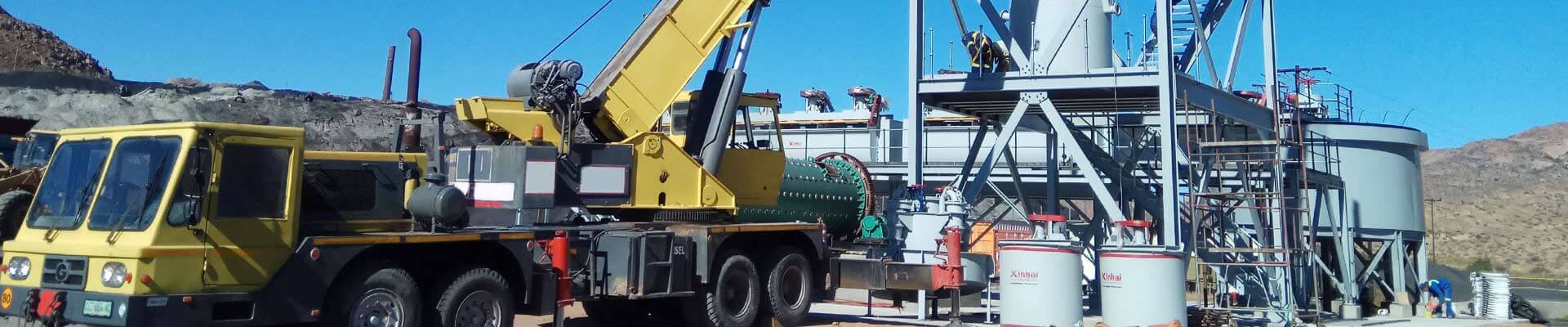
A South African chrome concentrator illustrates both points together. The plant ran 360,000 t/y on gravity, and as the ore changed, the concentrate drifted below the metallurgical specification while throughput fell.
Xinhai rebuilt the circuit around high-intensity magnetic separation: a vertical ring separator in roughing, cleaning and scavenging, with the scavenger concentrate returned to the cleaner in closed circuit. Capacity went to 480,000 t/y, concentrate grade rose by more than 20%, and moisture came out below 15%.
| Measure | Before | After |
|---|---|---|
| Capacity | 360,000 t/y | 480,000 t/y |
| Concentrate grade | Below metallurgical spec | Up more than 20% |
| Concentrate moisture | — | Below 15% |
The magnetic tailings were then reground and floated to recover platinum and palladium — a stream the original gravity-only circuit discarded. That part of the project repaid its cost in about 18 months.
These figures apply to that ore and that plant. They indicate what a stage change can do; they are not a forecast for another deposit.
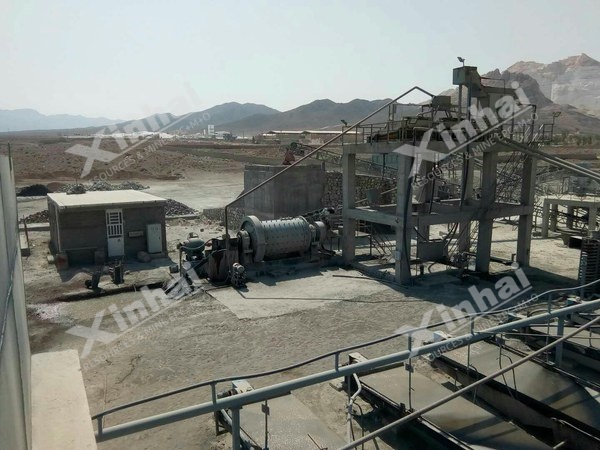
Ball mill and plant structure.
It depends on the liberation size of the ore. Coarse chromite in a coarse matrix can be liberated in the 0.1–1 mm range, while fine dissemination needs finer grinding. Over-grinding creates slimes that gravity cannot recover, so the target is set by testwork rather than by a fixed mesh.
Each device has a working size band. Jigs take 0.5–25 mm, spirals 0.1–2 mm and shaking tables 0.02–0.5 mm. Running them in sequence lets each fraction be treated where it separates properly, instead of forcing one machine across the whole size range.
It sits after gravity, to lift the Cr:Fe ratio and to catch fine chromite that gravity loses. Chromite is weakly magnetic and magnetite is strongly magnetic, so high-intensity separation can strip iron carriers without pulling out the chromite.
No. Coarse and fine dissemination, different gangue minerals and different concentrate targets each shift the circuit. Testwork on the actual ore is what decides the grinding size, the number of gravity stages and whether magnetic cleaning is needed.
Precision in chromite processing is not a matter of advanced instrumentation. It is a matter of matching each stage to the size band it can actually separate.
At Xinhai, we believe the flowsheet should be read off the ore, not off a template.
Share your chromite project with us. Let's start from the liberation size.
Sources
Chromite density around 4.2–4.8 g/cm3 against silicate gangue at about 2.6 g/cm3; jig, spiral chute and shaking table size bands, capacities and typical concentrate grades (jig 40–45% Cr2O3, spiral 42–47%, table 48–52%) — Xinhai documentation on chrome gravity separation as published on drytailingmachine.com.
Chromite weak magnetic response and the role of high-intensity magnetic separation in raising the Cr:Fe ratio — Xinhai chromite beneficiation documentation.
South African chrome concentrator upgrade (360,000 t/y to 480,000 t/y, concentrate grade up more than 20%, moisture below 15%, magnetic tailings reground and floated for platinum and palladium, payback about 18 months) — Xinhai project records.
Photos are from an operating chromite gravity plant supplied by Xinhai.
Editor's note: this article was rewritten on 28 October 2026. Unverifiable figures, patent and standard references, and the smelting and hydrometallurgy sections of the previous version have been removed.
 +86 13811510145
