If you want to know more information (such as product/process price, etc.), please contact us 24-hour telephone
Zimbabwe's chromite is not scattered across the country. Most of it sits in one geological feature, a narrow intrusion about 550 km long, and the ore's physical form — thin seams of hard rock in some places, clay-bound weathered material in others — sets every decision that follows.
That distinction is what a flowsheet has to answer. A hard-rock seam and a lateritic deposit of the same chromium grade need completely different plants.
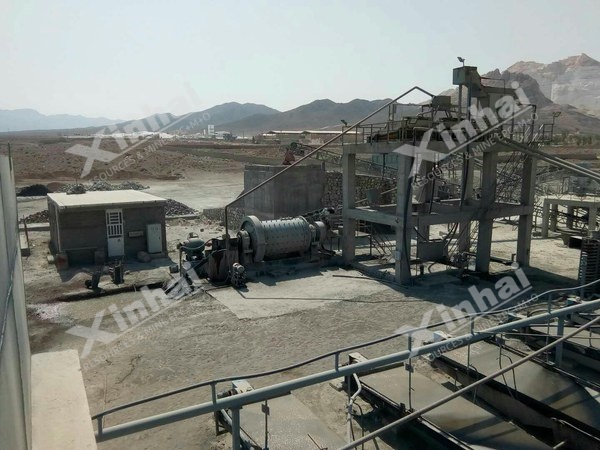
Chromite gravity plant
The Great Dyke is a linear body of mafic and ultramafic rock trending north-northeast through the Zimbabwe Craton. It is 550 km long and between 4 and 11 km wide, and it carries eleven laterally persistent chromite seams.
The seams are thin. Published descriptions put them at roughly 5–180 cm, and the same descriptions note that the great majority of Zimbabwe's chromite resource is this narrow stratiform type. Seams 1 and 2 are better exposed in the Middle and South Dyke; seams 2 to 10 are better exposed in the north.
Off the dyke, chromite also occurs as pods in ultramafic intrusions associated with greenstone belts — podiform deposits, notably around Shurugwi and Mashava. These are a much smaller share of the resource but a different processing problem again.
A seam measured in centimetres changes what mining has to do. The objective is not to move the most rock; it is to take the seam with minimum fragmentation and minimum contamination from wall rock.
The method used almost universally on the dyke is resue stoping, worked on breast faces where the dip is 30 degrees or less and on up-dip faces where it is steeper. The sequence runs in a specific order: the hanging wall waste is drilled and blasted first, then packed between timber props to fill the stope from footwall to hanging wall, with surplus — around 30% from swell — lashed to a waste pass and hoisted out. Only then is the chromite seam broken, lifted carefully to limit fragmentation, and the stope backfilled behind two rows of support close to the face.
The order matters because it is what keeps the ore clean. Blast the seam together with the wall rock and the dilution arrives at the plant already mixed in, where no amount of gravity separation will take it back out.
Where the dyke has weathered, the ore looks nothing like the seam. Chromite grains are already liberated from the host rock, but they sit inside sticky red clay, and the run-of-mine grade is correspondingly low.
Published work on Zimbabwean lateritic chromite describes clay content of 35–55%, with the chromite predominantly in the 0.05–0.3 mm range and run-of-mine grades of roughly 6–12% Cr2O3. The grains are free; they are simply wrapped.
That wrapping is what breaks gravity separation. Clay raises pulp viscosity so particles settle slowly and no longer separate on density. On spirals it films the trough and erases the separation zones; on tables it clogs the riffles until the concentrate band breaks up. The reported field picture is stark: without desliming, concentrate typically comes out below 38% Cr2O3 at under 60% recovery. With clay cut to below 8%, the same ore reaches 46–49% Cr2O3 at 82–88% recovery.
Two ore types, two circuits. Neither is a variation on the other.
| Ore type | What the plant must do | Leading equipment |
|---|---|---|
| Hard-rock seam | Crush and grind to liberate, then separate by density | Crushers, ball mill, jigs and spirals, tables |
| Lateritic / alluvial | Break the clay first, remove the fines, then separate | Trommel or drum scrubber, cyclones, two-stage spirals, magnetics |
For the weathered type the order is fixed by the clay. Scrubbing and screening come first, then desliming, and only then does gravity see the pulp. Published Zimbabwean practice uses a rotary scrubber followed by a trough-type scrubber in two stages, screening, and secondary desliming in hydrocyclones before spirals and tables; difficult ores get a dispersant such as sodium silicate.
Magnetic separation usually closes the circuit. Many Zimbabwean ores carry magnetite, and it is the magnetic stage that pulls the iron out and lifts the Cr:Fe ratio to a saleable band.
Two practical consequences follow from the geology.
Do not size for the resource average. The dyke's eleven seams differ in thickness and in weathering. A plant designed on a blended figure will be wrong at both ends.
Desliming is not an optional stage. For lateritic ore it is the difference between a concentrate that ships and one that does not, and the published gap is around ten points of Cr2O3 and over twenty points of recovery.
A third follows from the mining side: because resue stoping already controls dilution at the face, the plant is not being asked to fix a mining problem. Where dilution does arrive, no gravity circuit will recover it.
Mostly the Great Dyke, a linear mafic-ultramafic intrusion running some 550 km north to south through the Zimbabwe Craton. It hosts eleven laterally persistent chromite seams, with podiform chromite also occurring in greenstone belts off the dyke.
The seams are thin, commonly 5–180 cm, and the great majority of the resource is this narrow stratiform type. Selective stoping with waste packing is how the seam is taken without diluting it, since bulk mining would mix in far more wall rock than the seam can carry.
In weathered deposits the chromite is encased in sticky clay. That clay raises pulp viscosity and blinds spiral and table surfaces, so gravity separation stops working. Removing the fines ahead of gravity is what makes the difference between a low-grade and a saleable concentrate.
Scrubbing and screening first, then two-stage spirals, then magnetic separation to control the Cr:Fe ratio, then dewatering. The magnetic stage is what lifts the ratio into a saleable band when the feed carries magnetite.
In Zimbabwe, the ore type decides the flowsheet before any equipment is chosen.
At Xinhai, we believe the first question is not what to build, but what the ore actually is.
Share your Zimbabwean chromite project with us. Let's start from the seam, or from the clay.
Sources
Great Dyke dimensions (550 km long, 4–11 km wide), eleven chromite seams, seam exposure by dyke section, and resue breast stoping practice including the blast-and-pack sequence and about 30% swell — Zhao Jian Jian, "An Introduction for Dyke Underground Chrome Mining in Zimbabwe", Aspects in Mining & Mineral Science 12(4), 2024.
Seam thickness of 5–180 cm, stratiform versus podiform occurrence, Shurugwi and Mashava podiform deposits, tribute arrangements and export-ban history — "Best Practices for Supporting Artisanal and Small-Scale Mining in Zimbabwe", Midlands Province chromite survey.
Lateritic chromite characteristics (clay content 35–55%, chromite at 0.05–0.3 mm, run-of-mine 6–12% Cr2O3) and the desliming comparison (below 38% Cr2O3 at under 60% recovery without desliming; 46–49% Cr2O3 at 82–88% recovery with clay below 8%) — published technical note on Zimbabwean lateritic chromite desliming.
Alluvial circuit configuration in Zimbabwe (trommel scrubbing, two-stage spirals, magnetic separation for Cr:Fe control, cyclone dewatering) — published Zimbabwean alluvial chrome plant case records.
Equipment roles and stage selection — Xinhai chrome ore beneficiation documentation.
Editor's note: this article was rewritten on 28 October 2026. Unverifiable figures, company claims and third-party technology references in the previous version have been removed.
 +86 13811510145
